The Concrete Foundation of Numbers
Dr. Montessori believed that every child possesses a “Mathematical Mind”—an innate tendency to seek order, precision, and patterns. In her classroom, mathematics is never taught through abstract memorization of facts. Instead, it begins with the most concrete representation possible. The “Number Rods” allow the child to see and feel the physical difference between the quantities one through ten. The child handles a rod that is ten times larger than the first, creating a sensorial impression of magnitude. By pairing these quantities with the “Sandpaper Numbers,” the child makes a solid connection between a physical amount and its abstract symbol. This concrete foundation ensures that math is never a mystery, but a tangible reality.
The Decimal System and the Golden Beads
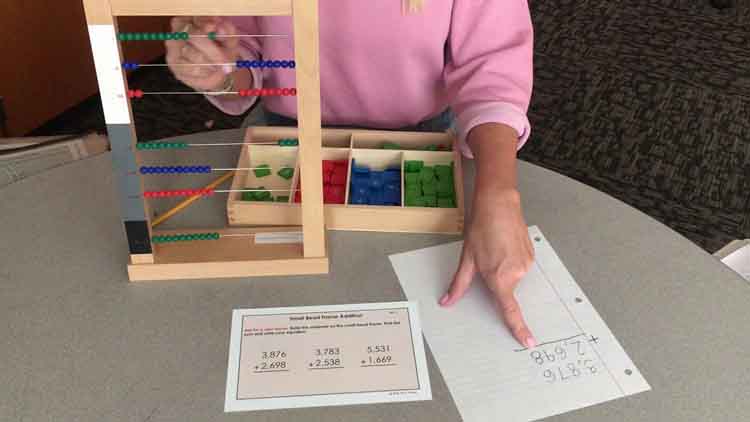
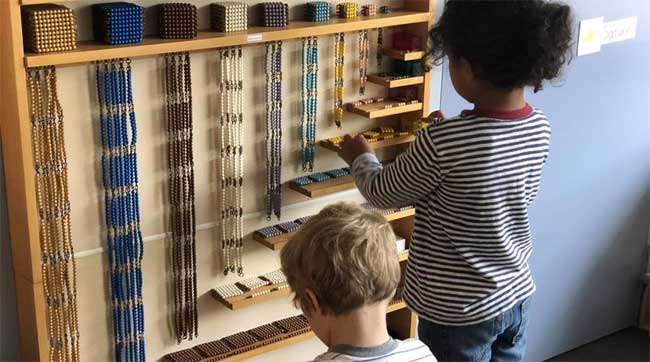
The introduction to the Decimal System is one of the most famous and beautiful Montessori lessons. Using the “Golden Beads,” children as young as four years old are introduced to the units, tens, hundreds, and thousands. They can physically hold a thousand-cube and realize it is composed of ten hundred-squares. They learn to perform addition, subtraction, multiplication, and division by physically manipulating these beads. This “Bank Game” allows them to understand the mechanics of regrouping and carrying in a purely visual and tactile way. When they eventually move to paper-and-pencil math, they can visualize the Golden Beads in their mind, making the transition to abstract calculation smooth and intuitive.
Moving Toward Linear Counting
Once the child understands the structure of the Decimal System, they move toward linear counting. Materials like the “Teen Boards” and “Ten Boards” help the child visualize the composition of numbers from 11 to 99. They see that 13 is actually ten and three. This clarity prevents the confusion that many children feel when learning the names of these numbers in English. The “Hundred Board” and the “Short Bead Stairs” further reinforce the sequence of numbers and the patterns within the base-ten system. Through constant repetition and the ability to correct their own mistakes using the materials, the child builds a deep sense of number sense that will serve as the backbone of their scientific and mathematical education.
The Joy of Mathematical Discovery
The goal of Montessori math is not to produce human calculators, but to foster a love for the beauty and logic of numbers. As the child moves through the curriculum, they begin to discover mathematical laws for themselves. They might realize that 3×4 is the same as 4×3 by looking at the “Bead Bar” arrays. This discovery is far more powerful than being told a rule. By the time the child enters the second plane of development (ages 6-12), they are ready for the “passage to abstraction,” where they can leave the materials behind and work entirely in their minds. Because their early experiences were so grounded in reality, they approach complex math with confidence, curiosity, and a sense of joy.