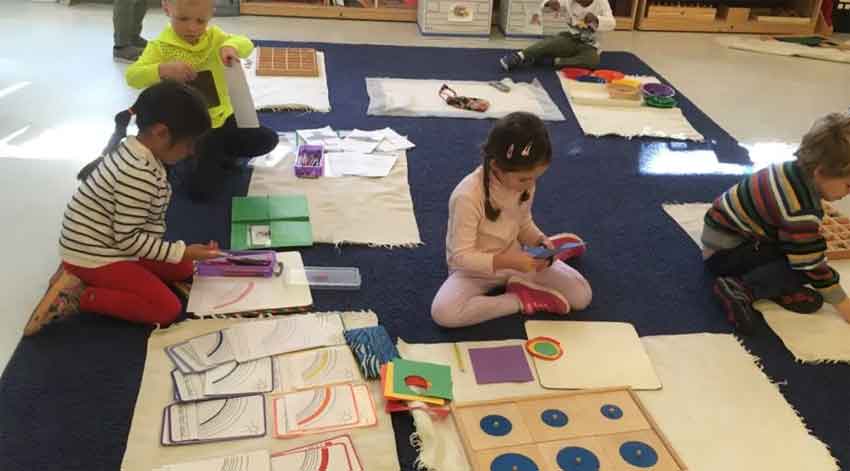
Montessori sensorial materials are meticulously crafted tools designed to help children refine and classify their sensory impressions. They are introduced to children after they have mastered the foundational skills of Practical Life. The purpose of these materials is not to teach a concept in the traditional sense, but to provide a concrete, hands-on way for a child to develop their senses of sight, touch, hearing, smell, and taste. Each material isolates a single quality, allowing the child to focus intensely on one attribute at a time. For instance, the **Knobbed Cylinders** come in a set of blocks where the only variable is size; the child must discern which cylinder fits into which hole. This activity hones their visual discrimination and prepares them for future mathematical concepts like volume and dimension.
Similarly, the **Color Tablets** isolate the quality of color, training the child’s eye to distinguish between various hues and shades. The **Geometric Cabinet** helps a child learn to visually discriminate between shapes, laying the groundwork for geometry. A crucial element of all sensorial materials is the **control of error**. The material itself will show the child if a mistake has been made, allowing them to self-correct and learn independently. If a cylinder doesn’t fit, or a color tablet is mismatched, the child knows they must try again. This self-correction process is incredibly empowering, as it frees the child from reliance on an adult and builds their confidence as a learner. The sensorial materials also indirectly prepare the child for other areas of the curriculum. For example, the **Red Rods**, which vary in length, prepare the child’s eye and mind for understanding length and sequencing, a fundamental skill for mathematics. The **Brown Stair**, which varies in thickness, prepares the child for concepts of dimension and volume. By working with these materials, children not only refine their senses but also develop a deep-seated sense of order, concentration, and precision, skills that are invaluable for all future learning. The sensorial curriculum is a beautiful bridge from the concrete world of physical objects to the abstract world of intellectual concepts. It is a crucial step in the child’s development, providing the sensory foundation upon which all future academic knowledge will be built.