
The **Montessori materials** are a cornerstone of the educational method, serving as the primary vehicle through which a child interacts with the prepared environment. They are not simply toys or manipulatives; they are precisely designed, self-correcting tools that act as a bridge, guiding a child from a concrete, sensorial understanding of the world to an abstract, intellectual one. But is this process a more effective pathway to learning than traditional methods, and is it a direct result of a dedicated **Montessori teacher training**?
### The Purposeful Design of Montessori Materials
Each **Montessori material** is a masterpiece of design. Dr. Montessori believed that a child’s mind, particularly in the early years, is not yet ready for pure abstraction. The mind needs to touch, to feel, to manipulate, and to see in order to truly grasp an idea. To this end, each material isolates a single concept, eliminating all other distractions. For example, the Cylinder Blocks focus only on visual discrimination of size and shape. The Pink Tower focuses solely on the visual discrimination of size. This isolation of difficulty allows the child to concentrate on one skill at a time, building a solid foundation before moving on to more complex concepts.
### A Progression from Concrete to Abstract
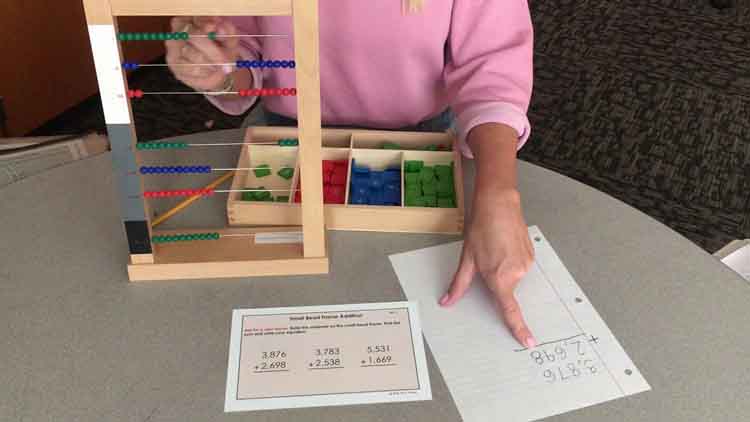
The materials are arranged in a carefully planned sequence, providing a clear path from simple, sensorial concepts to complex, abstract ones. A child might first work with the Geometric Cabinet, learning to recognize and name various shapes. This concrete, hands-on experience then prepares them for the abstract study of geometry. Similarly, the Golden Beads, which physically represent the decimal system, allow a child to concretely experience concepts of quantity, place value, and operations. By physically holding 1, 10, 100, and 1000, a child builds a deep, intuitive understanding that far surpasses what can be learned from a textbook alone. The Stamp Game then acts as an intermediate step, where the child uses stamped wooden tiles to represent the quantities from the Golden Beads, gradually moving away from the physical representation.
### The Role of the Teacher: A Guide, Not an Instructor
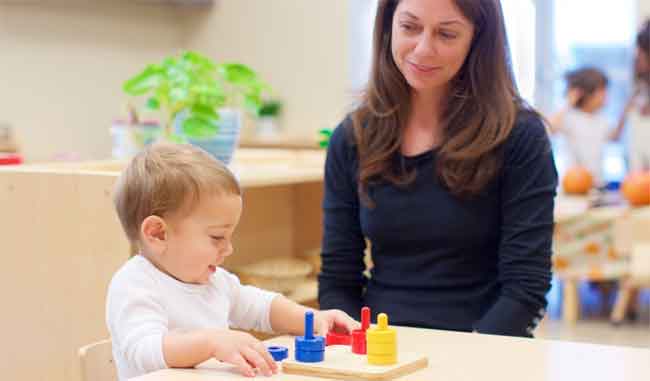
The success of the materials is inseparable from the skill of the educator, a skill cultivated during **Montessori teacher training**. The teacher’s role is not to simply hand over the materials, but to present them with a precise and engaging lesson. This presentation, known as a “lesson” or “presentation,” is often brief and to the point. The teacher shows the child how to work with the material, modeling a sense of purpose and concentration. The teacher then steps back, allowing the child to engage with the material on their own. This is where the magic happens. The child repeats the work, not out of compulsion, but out of an inner drive for mastery. This repetition leads to a state of deep concentration, which Dr. Montessori saw as the cornerstone of all true learning. A trained teacher knows when to intervene and when to simply observe, a skill that is paramount in this educational model.
### Beyond Academic Learning: Practical Life Materials
The **Montessori materials** also include a crucial set of tools for “Practical Life.” These are not for academic learning but for developing essential life skills, such as buttoning, tying, pouring, and sweeping. These activities, which seem so simple, are vital for a child’s development. They build coordination, concentration, and a sense of order. They also teach a child to care for their environment, fostering a deep sense of responsibility and self-worth. These activities, just like the academic materials, are a key part of the curriculum and are an integral part of **Montessori teacher training**.
### The Long-Term Impact
The **Montessori materials** are designed to empower a child to become a confident, self-reliant, and truly knowledgeable individual. By providing a structured, purposeful pathway from concrete to abstract, they lay a solid cognitive foundation upon which all future learning can be built. The materials also foster a deep sense of ownership and responsibility for one’s own education. In a world that often prioritizes rote memorization and passive learning, the Montessori approach stands out for its commitment to hands-on, self-directed exploration. Without these meticulously designed materials and the dedicated educators who are trained to use them, would the entire philosophy of child-led learning simply collapse? The Montessori philosophy suggests that the answer is a resounding no, because the materials themselves are designed to be the child’s best teacher.