From Sensory Input to Intellectual Order
Dr. Maria Montessori was a scientist, and her educational philosophy is deeply rooted in the biology of human development. She observed that young children learn not through abstract reasoning but through direct interaction with their environment via their senses. She famously stated, “The senses, being explorers of the world, open the way to knowledge.” The Sensorial curriculum area in a Montessori classroom is a direct application of this principle. The beautiful and intriguing materials—the Pink Tower, the Sound Cylinders, the Fabric Box—are often misunderstood as being designed merely to sharpen a child’s senses. While they do accomplish this, their ultimate purpose is far more profound. They are scientifically designed tools for building the child’s intellect. By systematically isolating and exploring sensory information, the child creates mental order, builds a framework for classification, and develops the very neural pathways necessary for complex thought.
The Neurological Basis of Sensory Learning
From birth, a child’s brain is being built by the information it receives from the senses. Every sight, sound, smell, taste, and touch creates and strengthens neural connections. The early years are a critical period for this neurological development. The Montessori Sensorial materials are designed to provide clear, organized, and rich sensory input at precisely the time the brain is most receptive to it. When a child holds the solid wooden cubes of the Pink Tower, they are not just seeing “big and small”; they are experiencing the concepts of dimension, weight, and volume through multiple sensory pathways. Their visual cortex processes the differences in size. Their proprioceptive sense processes the varying weights and the muscle movements required to carry each cube. This multi-sensory engagement creates a much deeper, more robust, and more permanent understanding of the concept than simply looking at a picture of a big and a small square. The materials are, in essence, a gymnasium for the developing brain, providing the exact “equipment” needed to build a strong cognitive structure.
Isolating the Senses to Refine Perception
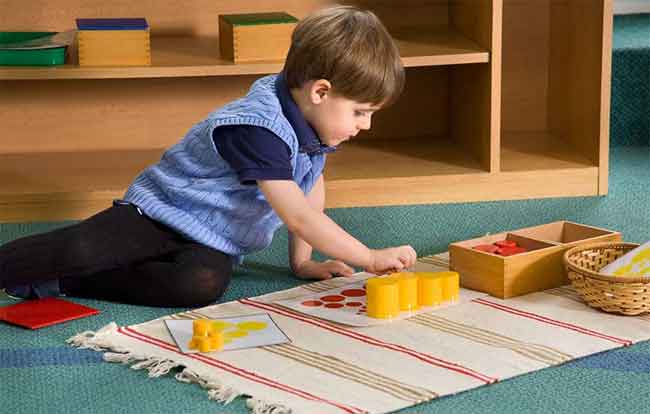
The genius of the Sensorial materials lies in their design principle of “isolation of quality.” Each material is crafted to highlight one specific sensory quality while keeping all other variables constant. For example, the ten cubes of the Pink Tower vary only in size; their color, shape, and texture are identical. This removes all distraction and allows the child to focus their entire attention on the single concept of “cubes of varying size.” Similarly, the Sound Cylinders are identical in appearance, weight, and texture; they differ only in the sound they make when shaken. The Thermic Tablets differ only in the way they conduct heat. This intentional isolation allows the child to refine each of their senses with incredible precision. It helps their brain learn to filter information and focus on specific details—a foundational skill for scientific observation. The child learns to compare, to grade from one extreme to another (like the lightest to the heaviest of the Baric Tablets), and to match identical pairs. This process of organizing tangible, sensory information is practice for the later work of organizing abstract ideas.
Building the Foundations for Math and Language
The Sensorial materials are a direct and indirect preparation for mathematics and language. The visual discrimination of size and dimension honed by working with the Pink Tower and Broad Stair directly prepares the child for understanding geometry. The Red Rods, which vary in length in ten equal steps, are a concrete introduction to the base-ten number system. The Binomial and Trinomial Cubes are physical representations of algebraic formulas that the child will encounter years later in abstract form. By experiencing these mathematical relationships in a concrete, sensorial way, the child builds a deep, intuitive understanding that makes future abstract work easy and logical. For language, the refinement of the auditory sense through the Sound Cylinders helps a child to better distinguish the subtle phonetic sounds of language, which is crucial for reading. The tactile experience of tracing the Sandpaper Letters is a sensorial activity that links the physical shape of a letter to its sound, laying the groundwork for literacy.
The Language of the Senses: Naming the Abstract
After a child has had extensive experience working with a material, the guide will introduce the corresponding language using a “Three-Period Lesson.” First, the guide names the quality: “This is large. This is small.” Second, the guide asks the child to recognize the quality: “Show me large. Show me small.” Finally, the guide asks the child to recall the name: “What is this?” This simple but powerful technique provides the child with the precise vocabulary to describe their sensory experiences. It connects the concrete, physical knowledge they have gained to the abstract world of language. This ability to name and articulate their perceptions completes the cycle of learning. The child’s world becomes more intelligible and organized, not just because they can perceive it accurately, but because they now have the words to describe and categorize their reality. This is the ultimate purpose of the Sensorial work: to take the chaos of sensory input and transform it into an ordered, intelligent, and articulate mind.