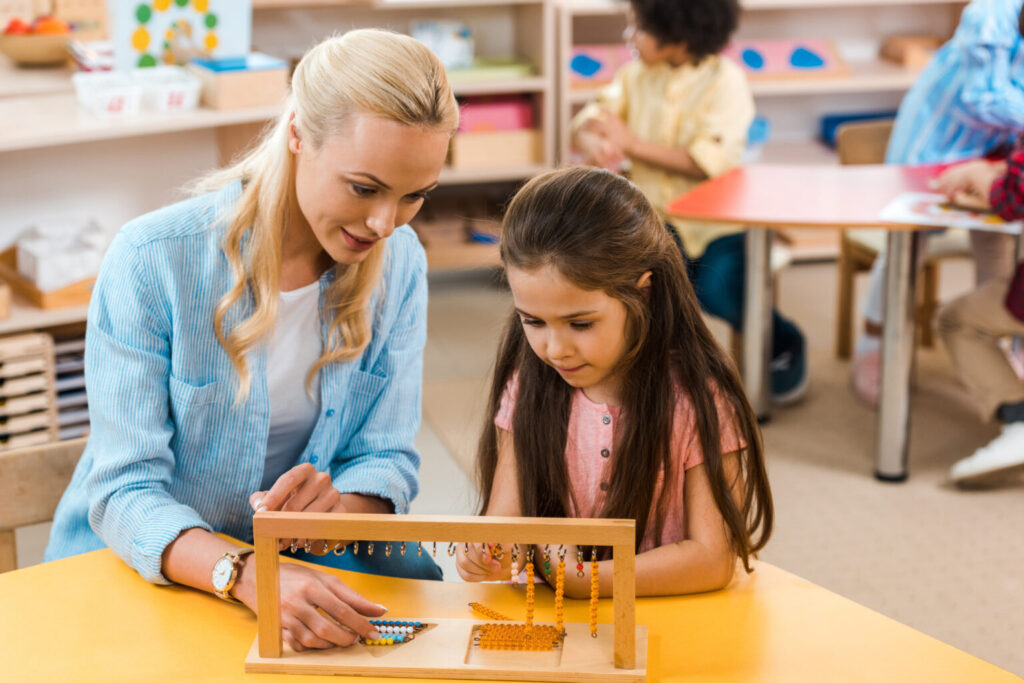
Observation is the cornerstone of Montessori education and one of the most refined professional skills a Montessori-trained adult can develop. In Montessori teacher training, observation is not treated as a casual act of watching children but as a disciplined, scientific, and reflective practice. Dr. Maria Montessori emphasized observation as the gateway through which the adult comes to understand the child’s inner life, developmental needs, and natural tendencies.
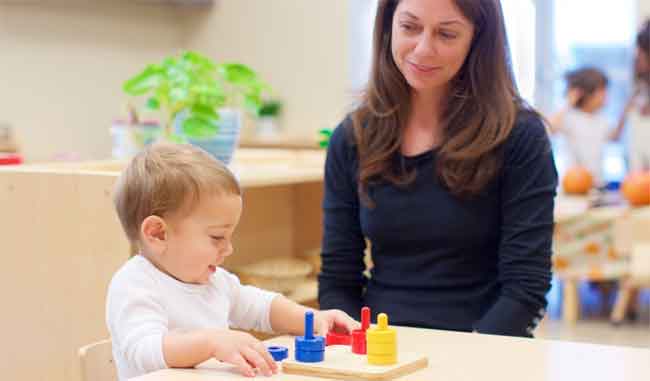
In a Montessori environment, the adult’s role is fundamentally different from that of a traditional teacher. Rather than directing learning, the Montessori guide prepares the environment and then steps back to observe. Through observation, the guide learns when to intervene, when to remain silent, and how to adjust the environment to support each child’s growth. Without strong observation skills, the Montessori philosophy cannot be practiced authentically.
Observation allows the Montessori teacher to see the child as they truly are, not as an adult expects them to be. It reveals sensitive periods, emerging interests, concentration cycles, and social behaviors. Over time, observation replaces assumptions with evidence and reactions with thoughtful responses.
During Montessori teacher training, observation is introduced as a foundational discipline. Trainees are taught that observation begins with stillness and humility. One must learn to quiet internal judgments, expectations, and comparisons. This mental preparation is essential because the quality of observation directly depends on the observer’s inner state.
A key objective of observation is to understand development. Children communicate their needs constantly through movement, choices, repetition, and behavior. When a child repeats an activity, avoids another, or appears restless, these actions provide valuable information. Observation helps the adult decode these messages and respond appropriately.
Another essential aspect of Montessori observation is understanding concentration. Montessori described concentration as the foundation of all learning and character development. Through careful observation, the teacher learns to recognize the signs of deep concentration and protects it at all costs. Interrupting a child’s concentration can disrupt not only learning but also emotional regulation.
Observation also supports individualized learning. In a Montessori classroom, children work at different levels and paces. Observation enables the teacher to track progress without relying on tests or worksheets. The adult notes mastery through repeated successful engagement with materials, independence, and confidence.
In Montessori training, observation is often practiced through structured exercises. Trainees observe classrooms, record objective details, and reflect on what they see. These exercises train the eye to notice subtle cues, such as posture, hand movements, facial expressions, and patterns of choice.
An important distinction emphasized in training is between objective and subjective observation. Objective observation records facts without interpretation, such as “the child selected the pink tower and completed it three times.” Subjective observation introduces interpretation, such as “the child was bored.” Montessori training encourages objective observation first, followed by thoughtful reflection.
Observation also plays a crucial role in classroom management. Many behavioral challenges arise when a child’s developmental needs are unmet. Through observation, the teacher can identify environmental mismatches, inappropriate material difficulty, or unmet movement needs, and make adjustments rather than resorting to discipline.
In Montessori teacher training, observation is closely linked to self-development. Trainees learn that their reactions, impatience, or need for control can interfere with accurate observation. As a result, observation becomes a mirror for self-awareness. The adult learns as much about themselves as they do about the child.
Observation further supports curriculum planning. Rather than following a fixed lesson plan, Montessori teachers base presentations on what they observe. If a child shows readiness for a new material, the teacher responds. If not, the teacher waits. This responsiveness ensures learning remains aligned with development.
The environment itself is also observed. Montessori guides assess whether materials are accessible, complete, and inviting. Observation helps determine whether the environment encourages independence, order, and concentration or whether adjustments are needed.
Over time, strong observation skills lead to trust in the child. Teachers trained in observation learn to respect the child’s pace and choices. This trust fosters confidence, autonomy, and intrinsic motivation in learners.
In conclusion, observation is essential in Montessori training because it forms the basis of understanding, respect, and effective guidance. It transforms teaching into a responsive, child-centered practice rooted in evidence rather than assumption. Without observation, Montessori education loses its depth and authenticity.
Observation is not a skill mastered quickly. It develops through practice, reflection, and humility. For Montessori teachers, observation is not just a professional tool—it is a lifelong discipline that deepens with experience and transforms the adult alongside the child.