
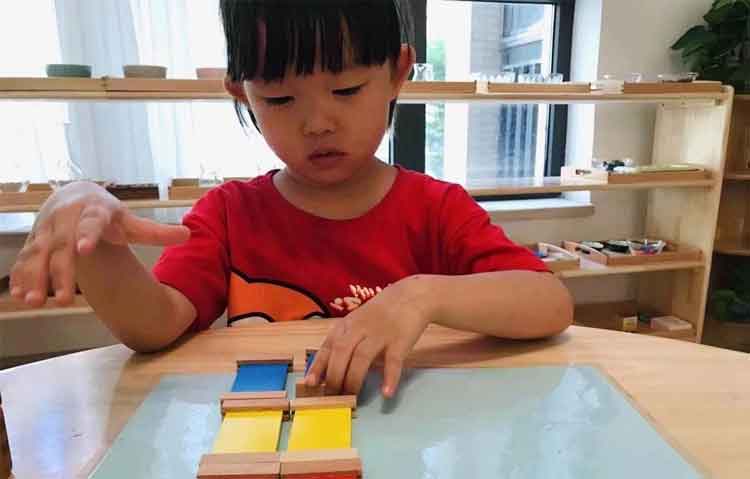
One of the most profound concepts articulated by Dr. Maria Montessori is the “absorbent mind,” a term she used to describe the unique mental capacity of a young child from birth to age six. During this period, a child’s mind is not just learning; it is unconsciously absorbing every aspect of the environment and culture around them, much like a sponge absorbs water. This absorbent mind is the engine of a child’s development, a concept that is deeply explored in **Montessori teacher training**. But is this period of unconscious learning a key to a child’s development, and how does the Montessori method capitalize on it?
### The Two Phases of the Absorbent Mind
Dr. Montessori identified two distinct phases of the absorbent mind. The first, from birth to age three, is the unconscious absorbent mind. During this phase, the child is absorbing everything from their environment without conscious effort or selection. They are learning to walk, to talk, and to understand the world around them at an astonishing rate. It is a period of pure, effortless creation. The second phase, from ages three to six, is the conscious absorbent mind. During this period, the child begins to refine and organize the knowledge they have absorbed. They become more purposeful in their work and are driven by a need to master their environment. This is when the child’s natural curiosity and desire to learn truly blossom.
### The Role of the Prepared Environment
The concept of the absorbent mind is what makes the prepared environment so critical. The environment is meticulously designed to provide a rich and stimulating experience for the child, while also providing a sense of order and peace. The **Montessori materials** are the key tools in this environment. They are designed to be beautiful and inviting, drawing the child in to explore. Because the child’s mind is absorbing everything, it is essential that the environment is purposeful and thoughtfully curated. This is why the materials are not just toys, but specific, self-correcting tools that help a child make sense of the world. A trained **Montessori** educator knows how to use these materials to guide the child’s absorbent mind, providing the right challenge at the right time.
### Capitalizing on Sensitive Periods
The absorbent mind is also intimately linked to the concept of “sensitive periods.” These are windows of time when a child is uniquely receptive to learning a specific skill, such as language, order, or the development of the senses. For example, a child in a sensitive period for order will be fascinated with organizing objects and putting things in their proper place. A trained **Montessori** educator recognizes these sensitive periods through observation and provides the appropriate materials to satisfy the child’s inner drive. This is in contrast to a traditional educational model, where the curriculum is delivered to a group of children regardless of their individual readiness. The Montessori method, by capitalizing on the absorbent mind and sensitive periods, allows for a more natural and effortless learning process.
### A New Perspective on Child Development
Understanding the absorbent mind is a cornerstone of **Montessori teacher training**. It fundamentally changes the way an educator views a child. Instead of seeing a child as a blank slate, they see a being with an immense, inborn capacity for learning and development. This perspective fosters a deep respect for the child’s independent efforts and a sense of humility in the educator. The teacher’s role is not to force knowledge upon the child, but to create an environment where the child can learn and grow at their own pace. This is a profound philosophical shift that has a lasting impact on an educator’s career.
### The Long-Term Impact
The absorbent mind, and the education that supports it, has a lasting impact on a child’s development. A child who is given the freedom to explore and learn at their own pace, and who is provided with a rich and stimulating environment, develops a deep sense of confidence, independence, and a lifelong love of learning. They learn to trust their own abilities and to take ownership of their own education. In an age where children are often overscheduled and under-stimulated, the Montessori approach offers a powerful antidote, a way to nurture a child’s natural curiosity and to help them reach their full potential. But is this period of unconscious learning truly the most important phase of a child’s life, and is it a direct result of a dedicated **Montessori teacher training**? The Montessori philosophy suggests that it is.