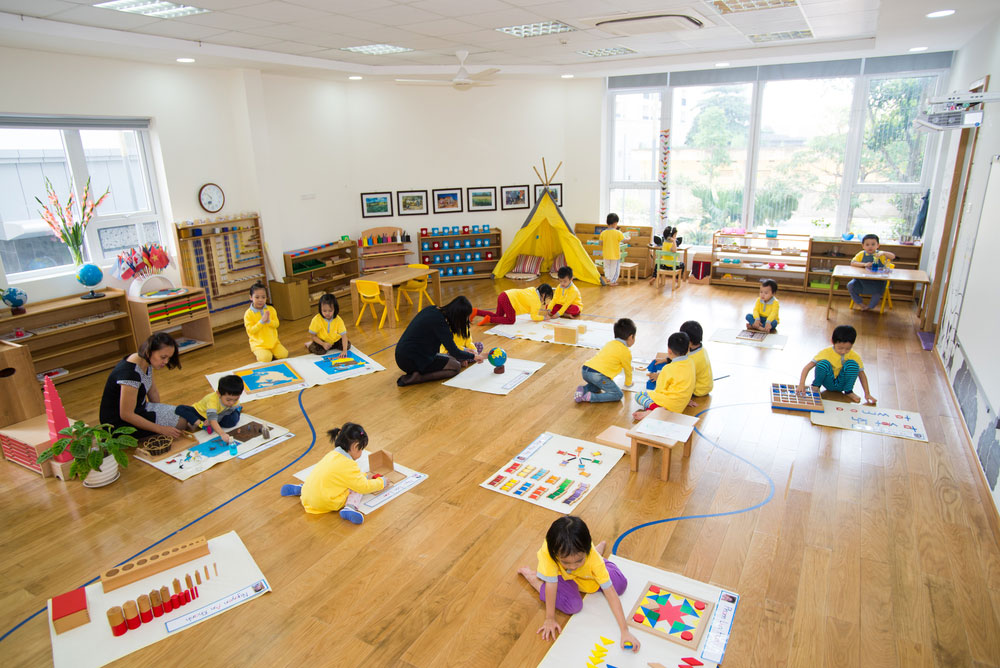

The Montessori approach to mathematics is a journey from the concrete to the abstract, and the materials are the essential vehicles for this transition. Unlike a traditional classroom where children learn math through abstract symbols on a worksheet, a Montessori child uses their hands and senses to build a deep, intuitive understanding of numerical concepts. The materials are designed to make abstract ideas tangible, allowing children to see and feel mathematical relationships before they are introduced to the symbols that represent them. This hands-on, experiential learning is the foundation upon which all future mathematical understanding is built.
The Golden Beads, for instance, are a cornerstone of the Montessori math curriculum. This set of beads represents the decimal system—single beads for units, a ten-bead bar for tens, a hundred-bead square for hundreds, and a thousand-bead cube for thousands. By physically holding and counting these beads, children grasp the concepts of place value and quantity in a profound way. They can literally see that ten units make up a ten-bar and that ten ten-bars make a hundred-square. This concrete experience demystifies the decimal system and provides a solid mental framework for understanding larger numbers and operations. The materials are also self-correcting, allowing children to work independently and discover their own errors.
As the child’s understanding grows, they move from concrete materials to a semi-abstract stage with materials like the Stamp Game and the Bead Frame, and finally to pure abstraction with written equations. The Bead Frame, similar to an abacus, allows children to perform complex operations like multiplication and division on a much larger scale than is possible with the Golden Beads, while still using a physical representation of numbers. The Stamp Game uses small wooden stamps with the numerical values 1, 10, 100, and 1000 printed on them, a step closer to the abstract numerals. This carefully sequenced progression ensures that a child never encounters an abstract mathematical concept without first having a solid, sensory-based experience to ground it. The materials empower children to see the logic and beauty in mathematics, transforming it from a dreaded subject into a fascinating field of discovery.