When people first encounter **Montessori materials**, they might be surprised by their apparent simplicity and lack of bright colors or fantasy-based themes. Unlike traditional toys, which are often designed to be entertaining and multifaceted, Montessori materials are purposeful, elegant, and often singular in function. This raises a common question: if these materials have a specific purpose and a “right way” to be used, do they stifle creativity? This is a core topic addressed in **Montessori teacher training**, where educators learn that the answer is not what it seems. In fact, a foundational understanding of the materials reveals that they are designed to cultivate, not limit, true creativity.
### The Foundation of Order and Precision
Creativity is not about chaos; it is about bringing something new into being. To do this effectively, a person must first have a solid foundation of knowledge and skills. The **Montessori materials** provide exactly this. For example, the Geometric Cabinet helps a child learn to discriminate between different shapes with precision. The Cylinder Blocks teach visual discrimination of size and the concept of a graduated series. The Brown Stair teaches the concept of thickness. These materials, and many others, are designed to give a child a precise and orderly understanding of the world. They build a foundation of knowledge and skills that are essential for creative thought. The materials teach a child to think logically, to solve problems systematically, and to pay attention to detail. Without this foundation, can a child truly be creative? The Montessori method suggests that creativity is not a random act, but a purposeful expression built upon a solid base.
### Freedom Within Limits
The concept of “freedom within limits” is a cornerstone of the Montessori philosophy, and it is a key to understanding how the materials foster creativity. While the materials themselves have a specific purpose, the child has the freedom to choose their own work. They are free to choose the material that interests them most, to work with it for as long as they need, and to work at their own pace. This freedom of choice is a powerful tool for fostering a child’s intrinsic motivation and curiosity, which are essential for creativity. The teacher, who has undergone **Montessori teacher training**, understands that their role is to provide the environment and the materials, and then to step back and trust the child’s inner drive to learn.
### The Creative Process and the Materials
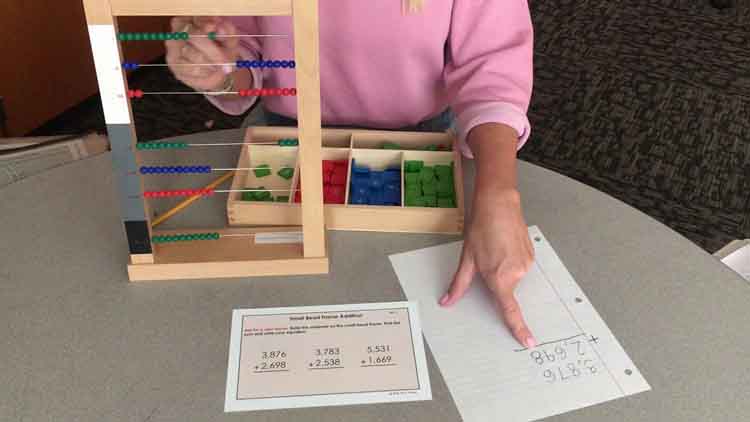
The creative process in a Montessori classroom is not about abstract, unplanned play. It is a process of exploration and discovery. A child who has mastered the concepts of geometry with the Geometric Cabinet might then use that knowledge to create a beautiful, intricate design with the Geometric Solids. A child who has mastered the Golden Beads might use that knowledge to create a new way of solving a complex math problem. The materials provide the tools, and the child’s creative mind uses those tools to create something new. This is in contrast to an environment where a child is simply given a box of random materials and told to “be creative.” In that environment, a child may become overwhelmed and frustrated. The Montessori materials provide a clear path to mastery, which in turn gives the child the confidence and the tools to be truly creative.
### The Role of the Trained Educator
The role of the educator in fostering creativity is paramount, a skill that is cultivated during **Montessori teacher training**. The teacher’s job is not to force creativity but to create an environment where it can flourish. They introduce the child to the materials with a brief, clear lesson, and then they step back, allowing the child to engage with the work on their own. They observe the child to see what they are interested in, and they provide new materials at the right time. They also provide a peaceful and respectful environment where a child feels safe to explore, to make mistakes, and to learn from them. This is a profound shift from the traditional teacher-centric model, and it is a skill that is meticulously taught in training. In conclusion, the **Montessori materials** are not a limitation on creativity; they are a foundation for it. By providing a clear path to mastery and a sense of order and purpose, they empower a child to become a confident, self-reliant, and truly creative individual. The Montessori philosophy suggests that true creativity is not a random act, but a purposeful expression built upon a solid base of knowledge and skill, and that this foundation is laid through the use of the materials and the guidance of a trained educator.