
Introduction: the preschool period and Montessori’s promise
Preschool represents a period of extraordinary growth. During these years children rapidly develop language, motor coordination, social understanding, and the basic cognitive scaffolds that support later learning. Montessori preschool activities aim to harness and direct this natural enthusiasm for exploration into structured opportunities that encourage independence, concentration, and joy in learning. This article explores the practical ways Montessori activities help preschoolers—by design, by pedagogy, and through the role of the prepared adult. The discussion below lays out how these activities are organized, why they are effective, and how parents and educators can implement equivalent strategies at home or in the classroom.
Prepared environment and accessibility
The prepared environment is the first practical lever Montessori uses to make learning possible. Shelves are low, materials are ordered and limited to a few purposeful choices, and the space is quiet and inviting. Everything in the room is scaled to the child: chairs, tables, utensils, and even sinks. This accessibility removes many physical barriers to action and makes it possible for preschoolers to perform meaningful tasks on their own. The presence of real tools—child-sized brooms, pitchers, tongs—signals trust and expectation: a child who can pour a cup or sweep a small area learns that they are capable and trusted to contribute. That feeling of agency feeds further attempts at independent work.
Practical life activities and foundational skills
Practical life exercises are deceptively simple but profoundly developmental. Activities such as pouring, transferring with spoons, buttoning frames, folding cloths, and food preparation strengthen fine motor control and bilateral coordination. They also teach sequencing: the child learns to gather materials, complete steps in order, and restore materials afterward. Beyond motor and procedural skill, practical life fosters concentration. When a child pours water from one jug to another and succeeds, they experience focused, satisfying work that encourages repetition. Repetition, in turn, leads to mastery. With mastery comes confidence, and with confidence comes willingness to tackle more complex tasks.
Sensorial materials shape perception and cognition
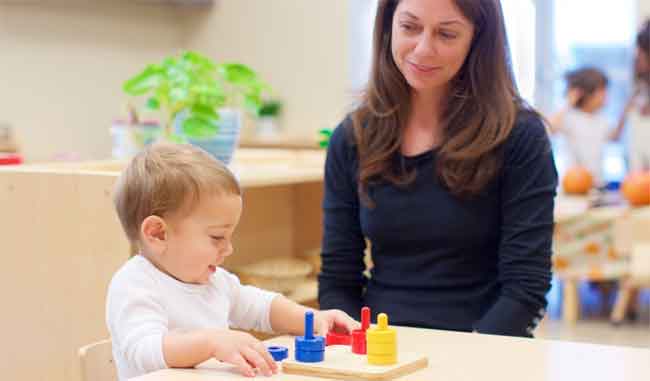
Montessori sensorial materials are designed to isolate a single quality—size, color, weight, texture, sound—so that children can refine their perceptual discriminations. Materials like the Pink Tower, the Brown Stair, color tablets, and sound cylinders provide clear, graded variation that helps children categorize sensory input. This refinement of perception supports later abstract thinking: by learning to notice differences in three-dimensional objects or subtle color hues, children build the cognitive habits necessary for mathematics, reading, and scientific reasoning. Sensorial work is therefore not mere play; it’s foundational cognitive training packaged as engaging, manipulative exploration.
Language development through rich interaction
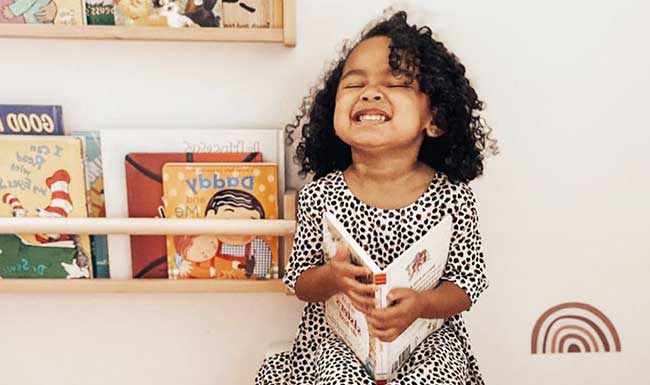
Montessori preschool strongly emphasizes language. Teachers model precise vocabulary, introduce classified cards, read stories, and engage children in conversation that stretches expressive ability. Tactile tools such as sandpaper letters and the movable alphabet allow pre-writing and phonemic work to be grounded in touch. Children trace letters while hearing associated phonetic sounds, linking sensory, motor, and auditory systems. These multisensory connections make language concepts stick, reducing the cognitive load when children later begin formal reading instruction.
Mathematical thinking from concrete to abstract
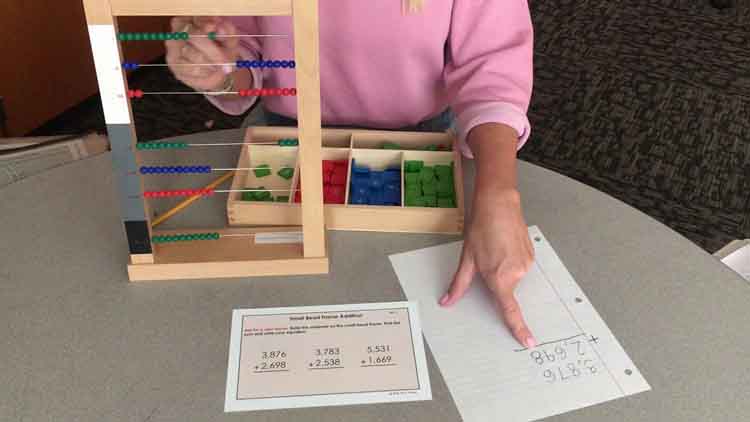
Early mathematical thinking in Montessori emerges from sensorially rich, concrete experiences. Counting beads, number rods, and golden beads provide concrete, manipulable representations of quantity, place value, and operations. A child who has physically created groups of tens and ones learns the conceptual basis for more abstract arithmetic later on. The progression from concrete manipulatives to symbolic notation (like numerals) is paced according to the child’s readiness, which reduces frustration and builds genuine understanding rather than rote memorization.
Concentration, repetition, and the formation of habits
Montessori classrooms protect the child’s right to concentrated work. Usually there are extended blocks of uninterrupted time when children can choose meaningful activities and return to them as needed. The teacher observes and offers individual lessons rather than directing the entire group simultaneously. This environment cultivates deep focus: children learn to follow their interest through multiple repetitions, refining skills and deepening understanding. Over time, the habit of concentrated, purposeful work becomes internalized and supports later academic tasks that require sustained attention.
Social dynamics and mixed-age benefits
Mixed-age classrooms are a distinctive Montessori arrangement that benefits preschoolers socially and academically. Younger children observe older peers modeling complex tasks; older children consolidate their learning through teaching and mentorship. This peer-to-peer structure fosters empathy, leadership, and collaboration. The social climate of respect—where materials are treated carefully and peers are observed during work—reduces interruptions and supports a culture of learning where children feel safe to take risks and learn from mistakes.
Role of the adult: guide, observer, and intervener
The Montessori adult is trained to prepare the environment, present lessons concisely, and then step back to observe. Intervention is intentional and minimal, aimed at supporting independence rather than replacing it. When a child struggles, the teacher offers gentle guidance: a demonstration, a hint, or an adjusted activity suited to the child’s developmental level. This approach ensures that help is available when needed but not so frequent that it undermines the child’s opportunity to practice problem solving and resilience.
Integrating Montessori ideas at home
Parents can adopt key Montessori principles without fully recreating a classroom. Start by creating accessible spaces: low shelves for toys and materials, child-sized utensils in the kitchen, and small routines that encourage responsibility—like a place to hang a coat or a child-friendly cleaning kit. Offer simple, real tasks and celebrate effort rather than perfection. Provide tactile materials for early literacy—sandpaper letters or letter tracing activities—and limit screen-based distractions during focused play. These small changes support the same dispositions Montessori cultivates: curiosity, autonomy, and concentration.
Assessment and progress: observation over testing
Montessori educators assess learning mainly through careful observation. Rather than relying on standardized tests, teachers watch how children approach tasks, how long they concentrate, and whether they show increasing independence or complexity in their work. Observation notes guide the timing of new lessons: when a child is ready for a more complex material, the teacher introduces it. This individualized pacing supports mastery and reduces the pressure that can undermine intrinsic motivation.
Challenges and common misconceptions
Despite its many strengths, Montessori is sometimes misunderstood. Parents may worry that Montessori lacks structure or academic rigor. In reality, Montessori has a precise structure—one that privileges a child’s self-directed activity within a carefully prepared framework. Another concern is cost and accessibility: authentic Montessori training and materials can be resource-intensive. However, the core principles—respect for the child, prepared environment, and emphasis on independence—are adaptable and can be implemented in low-cost ways at home or in community settings.
Long-term outcomes linked to preschool Montessori
Research suggests that early Montessori experiences can correlate with strong executive function, better social skills, and sustained intrinsic motivation. While outcomes vary across populations and programs, many former Montessori students report enduring benefits: comfort with independent learning, strong problem-solving abilities, and a love of hands-on exploration. Importantly, Montessori does not promise instant academic advantage; it cultivates underlying cognitive and emotional skills that support lifelong learning.
Conclusion: intentional activity creates lasting gains
Montessori preschool activities are not incidental play. They are carefully designed experiences that sequence motor, perceptual, language, and social learning in a way that respects the child’s developing capacities. By preparing an environment that invites independent action, offering sensory-rich materials, and valuing concentrated work, Montessori helps preschoolers build habits and skills that serve them across childhood and into adulthood. For parents and educators, the practical takeaway is clear: simplicity, accessibility, and respect for the child’s ability to learn through doing provide a powerful foundation for early development.