
Large families bring both joys and challenges into the homeschooling experience. Multiple children at different developmental stages create a lively household, full of opportunities for learning, cooperation, and independence. At the same time, balancing attention, resources, and energy across several children can feel overwhelming.
For families exploring hybrid Montessori homeschooling, the question arises: Can this model truly work for large families? The answer is yes—when Montessori principles are carefully adapted to suit the rhythms, needs, and strengths of bigger households.
- Mixed-Age Learning
- Montessori environments thrive on mixed ages. Older children naturally guide younger ones, while younger children observe advanced work.
- Large families already embody this principle at home, making Montessori a natural fit.
- Independence Through Prepared Environments
- Parents of large families cannot micromanage every child. Montessori’s emphasis on independence helps children care for themselves and their surroundings.
- Collaboration and Responsibility
- Shared chores and responsibilities become extensions of practical life.
- Children learn teamwork, accountability, and empathy.
- Freedom Within Limits
- Clear boundaries help maintain order even with many children.
- Children thrive when they know what freedoms they have and what limits guide the family rhythm.
- Shared Resources
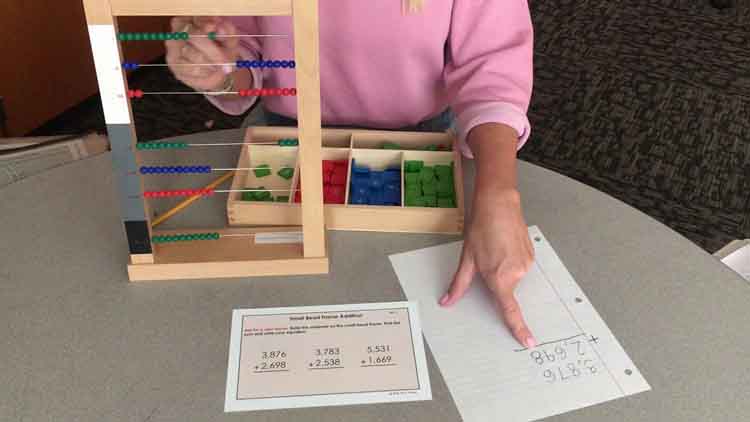
- Montessori materials can serve multiple children at different levels. For example, golden beads help one child with addition while another explores division.
- Peer Teaching
- Siblings naturally support one another’s learning, echoing the peer-to-peer teaching seen in Montessori classrooms.
- Community Support
- Hybrid co-ops provide a larger community where children build friendships outside their immediate family. Parents also gain support from like-minded adults.
- Flexible Schedules
- Hybrid models reduce the pressure of parents managing everything daily. Co-op days allow parents breathing space while children benefit from social learning.
- Material Sharing Conflicts
- Multiple children may want the same material at once.
👉 Solution: Teach patience, rotation systems, or provide duplicates of highly used items like sandpaper letters.
- Multiple children may want the same material at once.
- Space Limitations
- Large families may struggle to create enough quiet workspaces.
👉 Solution: Use room dividers, mats, or even outdoor areas to expand learning spaces.
- Large families may struggle to create enough quiet workspaces.
- Parental Bandwidth
- Parents may feel stretched thin observing and guiding multiple children.
👉 Solution: Older children can help introduce lessons to younger ones; parents can rotate focus daily.
- Parents may feel stretched thin observing and guiding multiple children.
- Consistency Across Ages
- Balancing toddlers, elementary-aged children, and teens at once can feel chaotic.
👉 Solution: Establish family rhythms (morning work cycles, afternoon outdoor play) that suit all ages.
- Balancing toddlers, elementary-aged children, and teens at once can feel chaotic.
Hybrid co-ops are particularly beneficial for larger families. They offer:
- Access to Expensive Materials: Families need not buy every item; co-ops provide shared access.
- Broader Social Networks: Children interact with peers of their own age outside the family.
- Shared Parental Duties: Parents contribute collectively, reducing the individual burden.
- Consistency of Structure: Co-ops provide reliable routines that complement home rhythms.
For large families, co-ops can prevent parental burnout while enriching children’s educational experiences.
- Design a Multi-Level Environment
- Dedicate different shelves for different age groups.
- Color-code materials or use trays to keep work organized.
- Rotate Work Cycles
- While older children work independently, parents can present short lessons to younger ones.
- Switch roles throughout the morning.
- Empower Older Siblings
- Encourage older children to help with practical life tasks or review concepts with younger siblings.
- This strengthens mastery and builds responsibility.
- Family Meetings and Planning
- Weekly meetings help distribute responsibilities and set shared goals.
- This reinforces Montessori’s emphasis on community and order.
- Simplify and Prioritize
- Not every material is essential. Focus on core math and language tools, supplement with DIY versions, and embrace real-life learning opportunities.
- Case Study 1: The Six-Child Household
Parents organize shelves by age group. Older children mentor younger ones, while co-op days give everyone access to materials like the bead cabinet. The home feels busy but purposeful. - Case Study 2: The Blended Age Group
A family with toddlers and teens uses hybrid homeschooling to balance needs. Toddlers focus on practical life at home, while teens pursue advanced projects in the co-op. The hybrid model ensures everyone’s needs are met without overwhelming parents. - Case Study 3: The Rural Large Family
Without access to a formal Montessori school, a rural family forms a small hybrid co-op with two other families. Together, they purchase expensive geography materials and rotate hosting days. The community becomes a lifeline.
Unlike many educational models that focus on uniform age groups and teacher-led instruction, Montessori embraces diversity and independence. Large families already function like mini Montessori environments:
- Mixed ages living and learning together.
- Practical life embedded in daily chores.
- Older siblings modeling and mentoring younger ones.
- Shared responsibility fostering community.
Hybrid Montessori simply extends this natural dynamic into a broader educational framework, adding co-op collaboration and community resources.
So, can hybrid Montessori work for large families? Absolutely. In fact, Montessori principles may align more naturally with the dynamics of big households than with smaller ones. With thoughtful preparation, collaboration, and reliance on co-ops, large families can thrive in this model.
The key lies in embracing independence, fostering collaboration, and prioritizing sustainability. Parents don’t need to do it all—they only need to prepare environments where children can do it for themselves.
In large families, Montessori becomes not just an educational method but a way of life, weaving learning into the daily rhythm of family life while balancing home and community.