For decades, the Indian education system has been largely shaped by a legacy of British colonial influence, emphasizing rote memorization, standardized testing, and a teacher-centric, top-down approach. Students are often seen as passive recipients of knowledge, and success is measured by the ability to reproduce information in examinations. The Montessori method, with its emphasis on individual liberty, self-directed learning, and hands-on exploration, presents a radical and welcome alternative. The differences are not merely cosmetic; they are rooted in fundamentally different views of the child and the purpose of education. While traditional Indian education often focuses on academic achievement and external validation, Montessori education is concerned with the development of the whole person—their physical, social, emotional, and spiritual well-being. The classroom is not a place of competition but of collaboration, and the teacher is not a lecturer but a guide. This shift in perspective leads to a host of practical differences that profoundly shape the learning experience, offering a powerful and transformative alternative to the conventional model. The Montessori method challenges the very foundation of traditional Indian schooling, advocating for an education that is not about filling a child’s mind, but about awakening their soul and spirit to their own innate potential. This difference is what made the Montessori philosophy so appealing to India’s early educational reformers, who sought to create a system that was both modern and deeply rooted in Indian values.
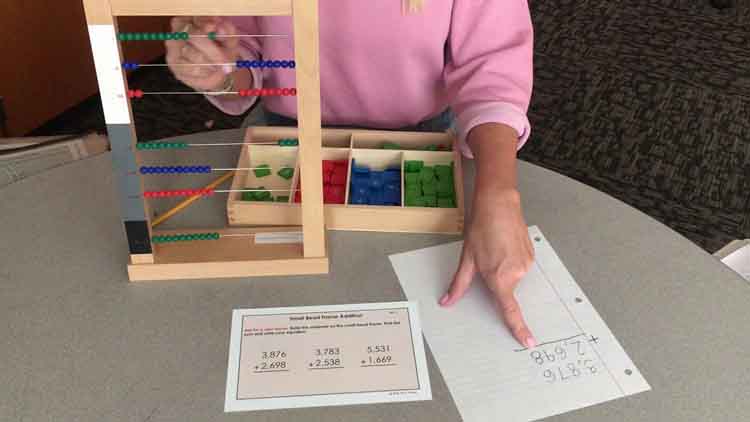
One of the most striking differences is the approach to curriculum and instruction. In a traditional Indian school, all children are typically learning the same thing at the same time, based on a fixed syllabus and a rigid schedule. The teacher stands at the front of the classroom and delivers a lecture, and the children sit in rows and take notes. In a Montessori classroom, the curriculum is not standardized; it is individualized. The educator presents a lesson to a single child or a small group of children based on their readiness and interest. Once a lesson is presented, the child is free to practice that work for as long as they need to, at their own pace. There is no rush, no pressure, and no competition. This is a radical departure from the traditional model, where children are often forced to move on before they have mastered a concept, or held back when they are ready to advance. The Montessori approach respects the child’s unique learning rhythm and ensures that they have the time and space to achieve a deep and lasting understanding. This is not about a lack of structure; it is about a different kind of structure, one that is flexible and responsive to the child’s needs. The materials themselves are also a key difference. While traditional Indian classrooms often rely on textbooks and blackboards, Montessori materials are hands-on, self-correcting, and aesthetically pleasing. A child learning about fractions, for instance, won’t be given a worksheet; they will work with a beautiful wooden fraction puzzle that allows them to physically manipulate the concept and understand it intuitively. The materials are designed to be “keys to the universe,” sparking a child’s curiosity and leading them from one area of study to the next in a logical and interconnected way. The Montessori classroom is a place of exploration, not just instruction.
The Role of Mixed-Age Classrooms in India
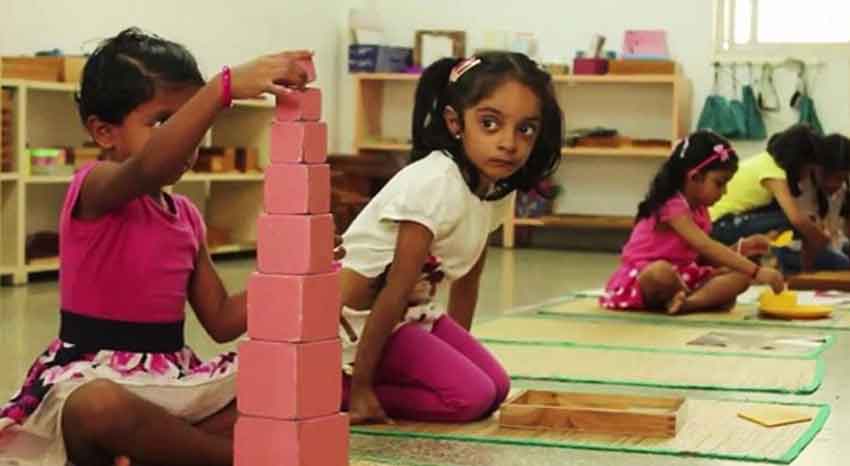
Another key difference is the use of mixed-age classrooms, a hallmark of the Montessori method that is rarely seen in traditional Indian schools. Rather than being grouped by age, children from different age groups (e.g., 3-6 or 6-9) learn together in the same classroom. This creates a family-like community where older children can act as mentors and guides to younger children, and younger children can learn from observing their older peers. This social dynamic is a powerful tool for learning. The older children develop a sense of responsibility and leadership, solidifying their own knowledge by teaching it to others. The younger children are inspired by what the older children are doing, and they see what they can look forward to. The social-emotional benefits are also immense. Children learn to interact with a wide range of ages, developing empathy, patience, and a sense of belonging. The mixed-age environment also mirrors the real world, where we don’t only interact with people our own age. This is in stark contrast to the traditional Indian model, where children are often segregated by age, which can lead to social and academic competition. The mixed-age classroom fosters a culture of collaboration and mutual respect, where every child is both a teacher and a student. It is a truly revolutionary approach to social development that recognizes the power of peer-to-peer learning and the importance of community. The teacher’s role is to facilitate this social ecosystem, to ensure that the interactions are positive and productive, and to guide the children in resolving their own conflicts. The mixed-age classroom is a testament to the idea that learning is a social and communal act, not just an individual one.
A Different Approach to Assessment and Discipline
The final key difference lies in the approach to assessment and discipline. In a traditional Indian school, success is often measured by standardized tests, grades, and external rewards. In a Montessori classroom, evaluation is a continuous, non-judgmental process based on the teacher’s observation and the child’s progress. There are no grades, no gold stars, and no red marks. The child’s work is its own reward, and the “control of error” in the materials provides immediate feedback, allowing the child to self-correct and learn from their mistakes. The teacher keeps meticulous records of each child’s progress, noting which lessons they have mastered and which they are ready for. This allows the teacher to provide tailored support and to ensure that the child is always working at their optimal level of challenge. The focus is not on comparing a child to a standardized benchmark but on celebrating their unique journey of growth. This approach to evaluation respects the child’s dignity and fosters a love of learning for its own sake, not for external validation. It teaches children that true success comes from within and that the process of learning is more important than the final grade. Similarly, the Montessori approach to discipline is centered on the concept of “inner discipline,” which is developed through purposeful work and a sense of belonging in a community. The teacher is not a disciplinarian but a guide, who helps the child understand the purpose of the limits and to develop the skills necessary to navigate them independently. By moving away from a system of external rewards and punishments, the Montessori method cultivates a deep and lasting sense of intrinsic motivation, which is the key to a lifetime of purposeful learning. The key differences in a Montessori classroom are not just about a different curriculum; they are about a different way of seeing the child—as a powerful, capable, and self-directed learner. And that changes everything.