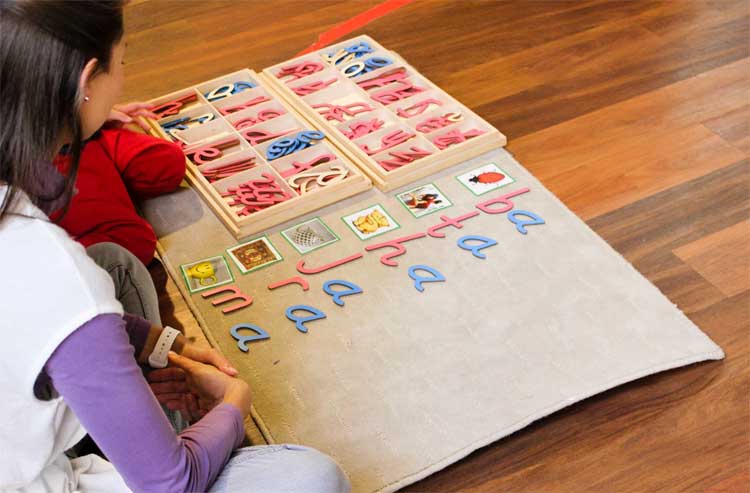
One of the most striking features of the Montessori approach to literacy is the separation of writing and reading. For an ESL student, this separation is a pedagogical masterstroke. Writing is an act of encoding—taking a sound and turning it into a symbol. Reading is decoding—taking a symbol and turning it into a sound. For a child learning the complex phonetics of English, the Moveable Alphabet allows them to “write” their thoughts before they have the motor skills to use a pencil or the phonetic synthesis skills required for reading.
In our teacher training sessions, we highlight how the Moveable Alphabet serves as a diagnostic tool for the guide. When an ESL child attempts to spell the word “ship” and uses the letters “s-e-p,” the guide gains immediate insight into the child’s phonetic development. We see that the child has not yet mastered the ‘sh’ phonogram or the short ‘i’ sound. In the Montessori tradition, we do not correct this spelling. Instead, we make a mental note to provide a targeted lesson later. This approach preserves the child’s creative spark and encourages them to express themselves in English without the fear of being “wrong.”
The phonetic consistency of the “Pink Series” is another essential component for the ESL learner. By focusing initially on three-letter, consonant-vowel-consonant words, we provide the child with a sense of success. They learn that the English alphabet can be logical and predictable. This foundation is crucial before moving into the more complex “Blue” and “Green” series, which introduce consonant blends and phonograms. For a child whose native language may be perfectly phonetic, such as Spanish, this structured ladder into the eccentricities of English spelling is especially supportive.
Finally, we use the Moveable Alphabet to bridge the gap between spoken and written English. We often play “Sound Games” or “I Spy” before introducing the letters. This ensures that the child has developed phonemic awareness—the ability to hear the individual sounds in English—before they are asked to represent them with symbols. By building from the sound to the letter, and from writing to reading, we follow a natural developmental path that respects the ESL child’s unique journey toward literacy. The Moveable Alphabet is not just a shortcut; it is a bridge that allows the child to cross the river of a new language with confidence and joy.