The Grammar Symbols and Their Essence
Grammar is often considered a dry and abstract subject, but in a Montessori classroom, it is a colorful, sensorial experience. Dr. Montessori developed a set of geometric symbols to represent the parts of speech. For example, the Noun is represented by a large black pyramid, signifying its ancient and stable nature. The Verb is represented by a large red sphere, signifying energy and action. When children begin to analyze sentences, they place these three-dimensional symbols over the words. This physical action turns grammar into a “lived” experience. The child can see and feel the relationships between words. By making the abstract rules of language concrete, we help the child develop a sophisticated understanding of how their language is structured.
The Function of Words
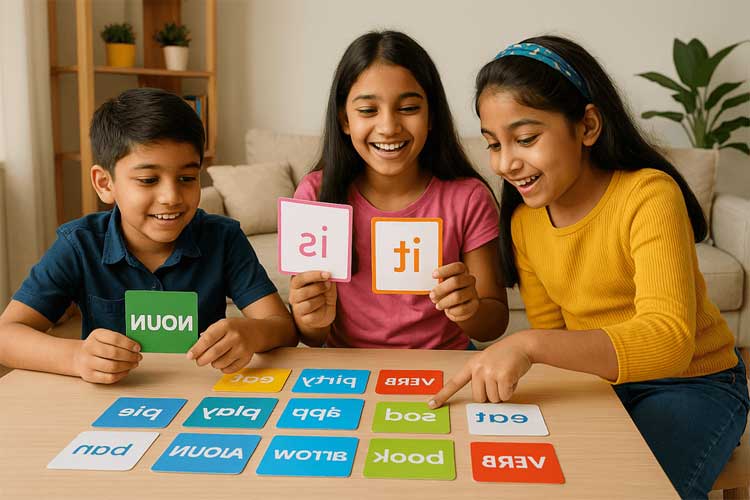
The study of grammar begins with “Function of Word” games. These are collaborative activities where the guide and the children explore the role of each part of speech. For the Adjective, the guide might ask the child to “Bring me the pencil.” When the child brings one, the guide says, “No, I wanted the long, red, sharp pencil.” This demonstrates that the function of the Adjective is to describe and distinguish. For the Preposition, we might place a bridge over a stream or a box on a table to show the relationship between objects. These games are fun and engaging, yet they lay the groundwork for high-level linguistic analysis. The child learns that grammar is not a set of arbitrary rules, but a logical system that helps us communicate clearly.
Building Sentences and Parsing
As the child’s reading skills grow, they begin to use the grammar symbols to parse more complex sentences. They might use the “Grammar Boxes,” which contain cards with sentences and sets of smaller, two-dimensional symbols. The child reads the sentence and then places the correct symbol above each word. This visual representation of sentence structure is an invaluable tool for developing clear writing skills. It allows the child to see patterns in language and to experiment with word order. In our teacher training, we emphasize that this work should be spontaneous and exploratory. The goal is to develop a “linguistic awareness” where the child notices the parts of speech in the books they read and the stories they tell.
Nourishing the Reasoning Mind
The study of grammar in the Montessori environment is designed to nourish the “Reasoning Mind” of the older preschooler and the elementary child. They are naturally driven to ask “why” and “how.” By providing them with the tools to analyze their own language, we respect their intellectual curiosity. This deep dive into the mechanics of language fosters a sense of wonder. The child realizes that language is a human invention, a beautiful and complex tool that we use to share our inner lives. This understanding leads to a deeper appreciation for literature and a more conscious use of their own voice. Grammar, in this context, is not a chore; it is an exploration of what it means to be a human communicator.