
Overview: two distinct educational philosophies
At a glance, Montessori and traditional teacher training programs share a common aim: to prepare adults who can help children learn. But beneath that shared objective lie different philosophies, methods, and priorities. Montessori training emphasizes observation, the prepared environment, child-led learning, and teacher-as-guide. Traditional training—often found in state teacher education and university programs—places a stronger emphasis on curriculum planning, standardized assessment, classroom management, and direct instruction techniques. Understanding the differences helps prospective teachers choose the pathway that best matches their beliefs about learning and their career objectives.
Philosophical foundations and learner view
Montessori pedagogy originates from Maria Montessori’s observations of the “absorbent mind” and the idea that children learn optimally through self-directed activity within a carefully prepared environment. Trainees study child development deeply and learn to respect and respond to sensitive periods of learning. Traditional programs typically represent a more teacher-directed epistemology: learners are guided through curricula designed by experts, and teaching focuses on delivering content, assessing outcomes, and meeting standards. Montessori training asks: how does the environment invite learning? Traditional training asks: how do we plan and assess learning objectives?
Structure of training and practicum
Montessori training programs often center on mastery of materials and pedagogy for specific age ranges (e.g., 3–6, 6–12). A strong Montessori course includes extended practicum hours in a Montessori classroom where trainees practice presentations, learn to observe, and receive mentorship. Traditional teacher education usually includes coursework in pedagogy, subject methods, child psychology, and classroom management, combined with a block placement in a school setting. While both include practicum, the Montessori practicum emphasizes precise, short demonstrations and observing children’s spontaneous work; traditional practica often require lesson planning for whole-class instruction and using standard assessment tools.
Focus on materials versus curriculum
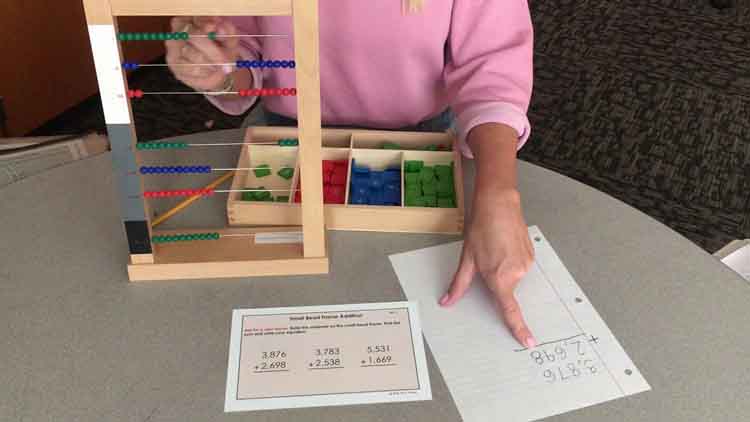
Montessori teachers are trained to use specific, often self-correcting materials that isolate single concepts. Training focuses on the sequence of presentations and the pedagogy of sensorial, practical life, language, and mathematics materials. In contrast, traditional training focuses on curriculum standards, lesson design across subjects, and adapting content for class-wide delivery. Montessori emphasizes depth—children explore materials until mastery—while traditional models balance breadth and alignment with external benchmarks.
Assessment approaches
Assessment in Montessori is primarily observational and qualitative. Teachers keep anecdotal records, work samples, and portfolios to track individual development. The goal is to note readiness, concentration spans, and the child’s progression through materials. Traditional training prepares teachers to use standardized tests, gradebooks, and measurable learning outcomes. While both approaches value evidence, they differ in tools and purposes: Montessori seeks individualized development trajectories; traditional systems frequently emphasize comparability and accountability to external standards.
Classroom management and freedom
Montessori classrooms operate on “freedom within limits”—children choose work within a structured environment and learn community norms like returning materials and working quietly. Montessori teacher training teaches how to set up those limits through environment design and routines rather than constant adult direction. Traditional teacher training emphasizes whole-class management strategies, transitions, and procedures for keeping large groups working on teacher-directed lessons. The skill sets overlap but are applied differently.
Teacher identity and stance
The Montessori teacher is trained to adopt a particular stance: observer, preparer, and subtle guide. This requires restraint, patience, and the ability to read subtle cues. Traditional training often positions the teacher as planner and instructor, who directs learning and structures the pace. Prospective teachers should reflect on which identity resonates: do you prefer facilitating individualized exploration or orchestrating structured lessons for a group?
Adaptability and hybrid models
Many modern educators blend elements of both. Some traditional schools incorporate Montessori-inspired centers or play-based learning, while some Montessori-trained teachers use assessment tools to communicate with parents and meet regulatory requirements. Training programs are increasingly offering hybrid courses—Montessori foundations plus modules on curriculum standards—to prepare teachers for diverse school contexts.
Career paths and recognition
Montessori certification (AMI, AMS, or other bodies) is often recognized by Montessori schools but may not substitute for state teacher licensure required in public school systems. Traditional teacher qualifications (a B.Ed. and state certification) are necessary for most public school positions. Candidates should consider their intended career trajectory when choosing a training route and may pursue dual qualifications where feasible.
Conclusion: choosing a pathway
Choosing between Montessori and traditional teacher training is a matter of alignment—philosophical, practical, and professional. Both routes equip teachers to support children’s learning, but they emphasize different tools, identities, and outcomes. Prospective teachers should visit classrooms of both types, reflect on their personal teaching philosophy, and consider practical career goals when deciding which training best suits them.