The Explosion into Writing
One of the most surprising discoveries Maria Montessori made was that children naturally “explode” into writing before they are capable of reading. In a Montessori environment, we separate the technical skill of handling a pencil from the intellectual skill of encoding sounds into symbols. Children prepare their hands for writing through Practical Life and Sensorial work, while they learn the phonetic sounds of the English language through the “Sandpaper Letters.” When a child realizes that they can put these sounds together to represent their own thoughts, they begin to “write” using the “Moveable Alphabet.” Because they are not yet burdened with the mechanical difficulty of a pencil, their creativity and linguistic expression are allowed to flourish early on.
Phonetic Awareness and the Moveable Alphabet
The Montessori approach to literacy is strictly phonetic. We do not teach the names of the letters (A, B, C) initially; instead, we teach the sounds they make (/ah/, /bu/, /cu/). This allows the child to immediately begin “composing” words. With the Moveable Alphabet—a box of wooden or plastic letters—the child can build words like “cat” or “pig” by simply listening for the sounds. This is an act of encoding. It is much easier for a child to take a thought and break it into sounds than it is to take a set of abstract symbols and synthesize them into a word (reading). By allowing children to write first, we build their confidence and their phonemic awareness, creating a solid foundation for the more complex task of reading.
Preparing the Hand for the Pencil
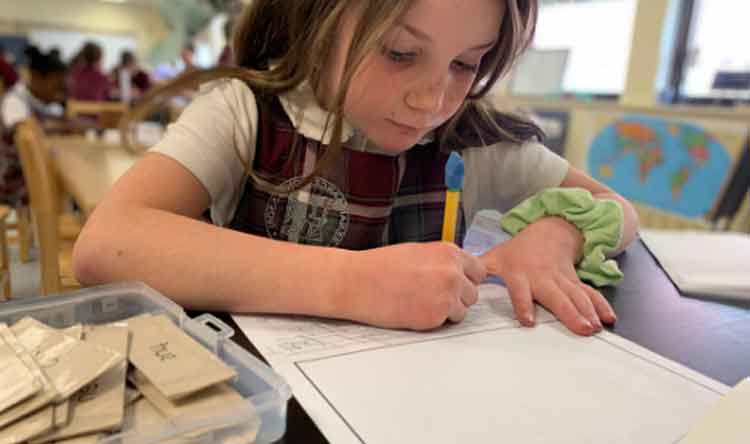
While the child is intellectually composing words with the Moveable Alphabet, they are also physically preparing for the pencil through the “Metal Insets.” This material is a technical marvel in the Montessori classroom. The child traces geometric shapes and then fills them in with careful, parallel lines. This work develops the fine motor control, the “pincer grip,” and the muscular memory required for handwriting. Because this work is artistic and sensorial, the child finds it deeply engaging. They are practicing the mechanics of writing without the pressure of producing letters. By the time they are asked to write a letter on paper, their hand is already strong, steady, and prepared, making the transition seamless and joyful.
The Total Language Experience
Language in the Montessori classroom is not a separate subject; it is integrated into every part of the day. From the nomenclature of the botany cabinet to the stories told during “Circle Time,” the child is immersed in a rich linguistic environment. We provide the “Three-Period Lesson” to ensure that the child is moving from concrete objects to abstract words. Reading eventually follows writing as a spontaneous discovery. Once the child has composed many words of their own, they begin to realize they can “read” the words of others. This “Total Language” approach ensures that literacy is not a chore to be learned, but a natural and exciting extension of the child’s desire to communicate and understand their world.