Maria Montessori’s connection with India is a profound and transformative chapter in the history of education. Forced to leave Europe during World War II, she found a home and a fertile ground for her ideas in India, where she lived for nearly seven years. During this period, from 1939 to 1946, she was not just a guest but an active participant in the country’s intellectual and educational discourse. Her presence had an immediate and lasting impact, influencing a generation of educators and thinkers. She traveled extensively, lectured to large audiences, and established her first training center in Chennai (then Madras). The Indian environment, with its deep philosophical traditions of respect for nature, contemplation, and the wisdom of the individual, resonated deeply with her own principles. She saw in the Indian child a spiritual potential and an innate sense of discipline that she had only theorized about before. Her work in India was not just about transplanting a European method, but about a cross-cultural exchange that enriched the Montessori philosophy itself. The enduring legacy of this period is a powerful testament to the universal appeal of her ideas and their remarkable adaptability to different cultural contexts. The seeds she sowed during her stay have since blossomed into a thriving network of Montessori schools and a deep-seated respect for her educational philosophy across the Indian subcontinent.
The philosophical and cultural parallels between Montessori’s work and traditional Indian thought are a key reason for her success in the country. Indian philosophy, particularly the concepts of self-realization (atman) and inner peace (shanti), aligns seamlessly with Montessori’s emphasis on the child’s inner development and the importance of a prepared, tranquil environment. The idea of the “prepared environment” found a natural echo in the traditional Indian Gurukul system, where the environment was a living part of the education process. Furthermore, Montessori’s reverence for the child as a spiritual being with a unique purpose resonated with the Indian concept of every individual having a unique dharma or purpose in life. Her emphasis on quiet contemplation and focused work found a cultural home in a society that valued meditation and introspective learning. The Montessori materials, with their logical progression and self-correcting nature, were seen as a modern embodiment of the traditional Indian approach to learning through hands-on activity and self-discovery. This philosophical synergy made it easier for Indian educators and parents to embrace her method, not as a foreign import, but as a natural extension of their own cultural values. The legacy of this period is not just a collection of schools, but a deep-seated intellectual tradition that has integrated Montessori’s principles into the very fabric of Indian educational thought. It is a powerful example of how a universal philosophy can find a home and flourish in a new cultural context, enriching both the philosophy and the culture it touches.
The Rise of Montessori Teacher Training in India
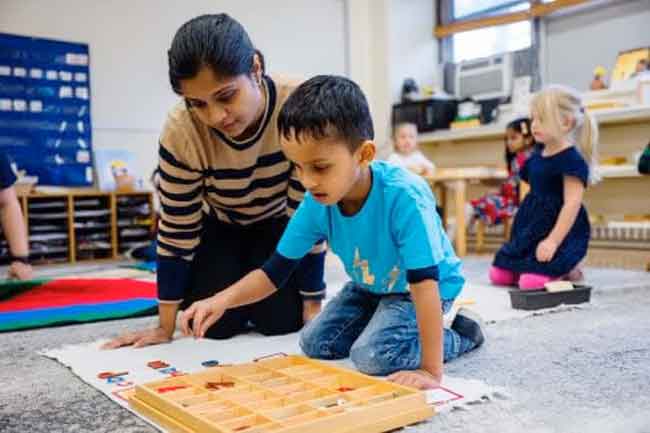
One of the most significant and lasting impacts of Maria Montessori’s time in India was the establishment of teacher training centers. She recognized that the success of her method depended entirely on the quality of the educators who would implement it. She personally trained a large number of teachers, and her son Mario Montessori continued this work, establishing the Indian Montessori Training Courses (IMTC). These courses, and others that followed, became the bedrock of the Montessori movement in India. The training went beyond a simple curriculum; it was a profound personal and philosophical journey for the trainees. They were taught to see the child not as a vessel to be filled with information, but as a person with immense potential. They learned the art of observation, the importance of inner preparation, and the skill of creating a prepared environment. The training was a transformative experience that changed not just how they taught, but how they saw the world. This emphasis on training created a strong and dedicated community of Montessori educators who were able to carry the torch of the philosophy forward. Many of the early trainees went on to establish their own schools and training centers, creating a ripple effect that spread the method across the country. The legacy of these early training courses is a testament to the power of a single person’s vision to inspire a movement. The teachers trained in India were not just practitioners; they were missionaries, dedicated to sharing the profound and transformative power of the Montessori method with others. This commitment to training and professional development is what has allowed the Montessori movement in India to not just survive, but to thrive and to grow into a powerful force for educational change.
Challenges and Future Directions for Montessori in India
Despite its rich history and enduring legacy, the Montessori movement in India faces its own unique set of challenges. One of the biggest is the aformentioned issue of authenticity and standardization. With the rise in popularity of the method, many schools have adopted the “Montessori” name without a genuine understanding of its core principles. This can lead to a dilution of the philosophy and a misrepresentation of the method. The challenge for the authentic Montessori community in India is to educate parents and the public about the difference between a true Montessori school and a “Montessori-inspired” one. This requires strong leadership, clear communication, and a commitment to upholding the highest standards of the philosophy. Another challenge is the integration of Montessori principles into the larger Indian educational system. While many private schools have embraced the method, it is not yet widely adopted in public schools, which serve the vast majority of the population. The challenge is to find a way to make the method accessible and affordable to a wider audience without compromising its integrity. This requires innovative thinking, a willingness to adapt, and a strong partnership between the public and private sectors. The future of Montessori in India lies in its ability to address these challenges and to continue to evolve while staying true to its core principles. The enduring legacy of Maria Montessori’s time in India is a testament to the power of her ideas to transform education. It is a legacy that is not just a part of history, but a living and breathing force that continues to shape the lives of countless children across the subcontinent. The future of Montessori in India is bright, but it will require a new generation of leaders and educators to carry the torch forward, with the same passion, dedication, and unwavering commitment to the child that Maria Montessori herself demonstrated during her time in the country.