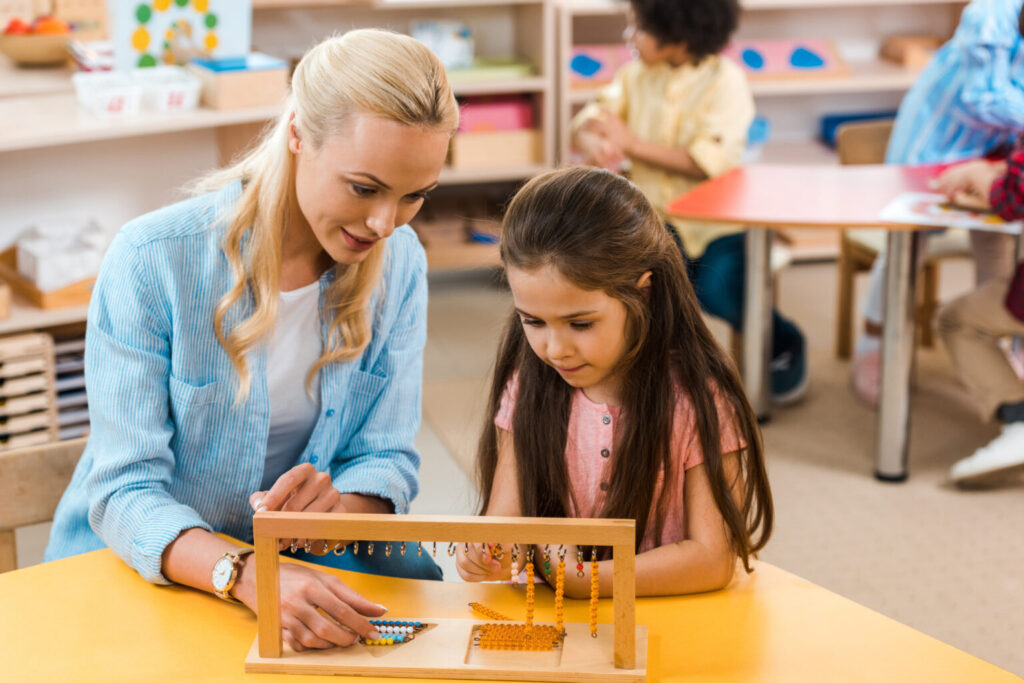
Why Materials Matter in Montessori Education
In Montessori education, materials are more than teaching aids—they are carefully designed tools that embody abstract concepts in tangible, hands-on ways. From sandpaper letters to golden bead chains, Montessori materials allow children to move from concrete exploration to abstract understanding at their own pace.
For families choosing hybrid Montessori homeschooling, materials play a central role. At home, they provide children with self-directed learning opportunities, while in community or co-op days, they allow for shared exploration and peer collaboration. But with so many materials available—and often at significant cost—parents often ask: Which ones are essential for hybrid homeschooling?
The answer depends on age, budget, and access to co-op resources. A thoughtful balance of core materials, DIY alternatives, and community-shared resources can ensure children have the tools they need to thrive without overwhelming families.
Core Materials for Early Childhood (Ages 3–6)
The early years in Montessori focus on sensorial development, language foundations, mathematics, and practical life skills. For hybrid homeschooling, some of the most essential materials include:
Practical Life Tools
Child-sized brooms, dustpans, pitchers, and utensils
Dressing frames (buttons, zippers, snaps)
These can easily be substituted with real household items scaled to children’s size.
Sensorial Materials
Pink Tower (ten graduated cubes to refine visual discrimination)
Broad Stair and Knobbed Cylinders (introduce size and dimension)
Color Tablets (explore primary, secondary, and gradations of colors)
DIY options: nesting boxes, stacking toys, or paint samples.
Language Materials
Sandpaper Letters (introduce phonetic sounds through tactile tracing)
Movable Alphabet (for building words before writing)
Classified Picture Cards (vocabulary building and categorization)
Math Materials
Number Rods (understanding quantity and order)
Golden Beads (place value and decimal system)
Spindle Boxes (zero and counting practice)
DIY alternatives: craft sticks, beads, or number cards.
These materials form the foundation of Montessori at home and can be extended in co-op settings where children work together with larger or more complex resources.
Essential Materials for Elementary (Ages 6–12)
Elementary Montessori emphasizes imagination, research, and cultural exploration. Hybrid homeschooling makes this stage especially rich, as children can investigate at home and collaborate in community settings. Key materials include:
Mathematics Materials
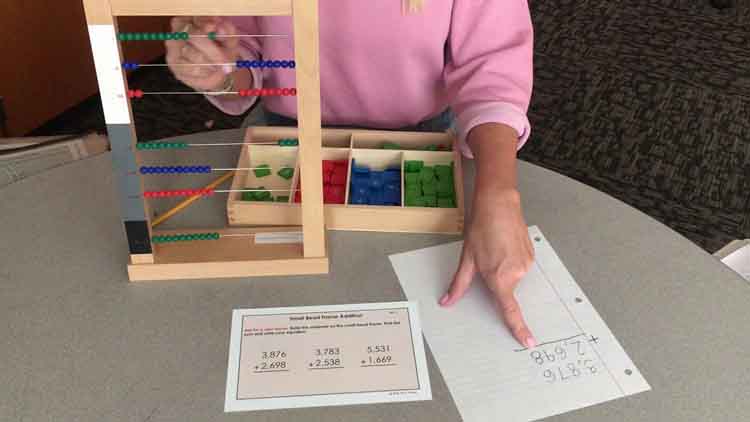
Stamp Game (abstract operations with numbers)
Bead Chains and Squares (multiplication and squaring concepts)
Fraction Insets (hands-on fractions and equivalence)
DIY options: fraction circles made from cardboard, colored paper bead chains.
Language Materials
Grammar Symbols (shapes that represent parts of speech)
Word Study Materials (prefixes, suffixes, root words)
Sentence Analysis Charts
Many of these can be printed and laminated at home.
Cultural Materials
Puzzle Maps (continents, countries, landforms, waterforms)
Timeline Charts (prehistory, civilizations, inventions)
Science Experiment Kits (often shared in co-ops to reduce costs)
Research Tools
Access to books, encyclopedias, and digital resources
Journals and notebooks for recording independent projects
Nature exploration kits (magnifying glasses, field guides, sketchbooks)
In hybrid models, families often divide responsibilities: co-ops provide larger materials like bead cabinets, while homes focus on smaller sets and practical research supplies.
Budget-Friendly and DIY Options
One common concern is the cost of authentic Montessori materials. While they are beautiful and precise, they can also be expensive. Hybrid homeschooling families can make thoughtful choices:
Invest in Core, DIY the Rest: Prioritize durable math and sensorial materials, which are hardest to replicate. Language and cultural materials are often easier to DIY.
Rotate and Share: Co-ops allow families to rotate materials, so no one household has to own everything.
Use Nature as Material: Rocks, shells, leaves, and seeds provide sensorial exploration and classification opportunities.
Repurpose Household Items: Measuring cups become math tools, kitchen spices become sensorial smell jars, and buttons serve as counters.
The Montessori principle is not about the material itself but about how it invites exploration, independence, and self-discovery.
Organizing Materials in a Home Environment
A prepared environment is essential. Children must be able to see, reach, and independently choose materials. For hybrid Montessori homeschools:
Use low, open shelves to display materials attractively.
Limit the number of items to avoid overwhelm—rotate weekly or monthly.
Keep materials complete and ready to use (no missing pieces).
Designate a workspace with a child-sized table or floor mat.
Include both academic and practical life tools to emphasize balance.
At co-ops, materials are often organized communally, and children learn to respect and care for shared resources. This mirrors the Montessori classroom experience.
How Hybrid Models Influence Material Choices
Hybrid Montessori homeschooling requires families to think strategically:
At Home: Focus on practical life, sensorial, and smaller academic tools that reinforce daily independence and learning.
In Co-ops: Utilize larger or more advanced materials that benefit from group collaboration (e.g., Great Lesson timelines, bead cabinets, or geography charts).
Transition Between Settings: Create continuity by aligning home materials with co-op lessons. For example, if a co-op introduces the Stamp Game, the child can continue practicing with a smaller set at home.
This balance allows children to deepen understanding across environments without unnecessary duplication.
Examples of Hybrid Material Use
Case Study 1: Early Childhood Home-Co-op Blend
A family invests in sandpaper letters, a movable alphabet, and pink tower for home use. In the co-op, children access the bead cabinet, continent maps, and cultural materials. The two environments reinforce each other.
Case Study 2: Elementary DIY Innovators
Parents create DIY grammar symbols, fraction circles, and history timelines at home, while the co-op provides authentic golden bead chains and science labs. Children bring their journals back and forth, connecting home and community learning.
Case Study 3: Minimalist Approach
A rural homeschooling family uses primarily practical life and nature-based materials at home while attending a weekly Montessori community day with access to sensorial and academic materials. Despite fewer physical tools at home, the Montessori philosophy thrives through observation, independence, and exploration.
Conclusion: Choosing Materials That Support Montessori at Home and Beyond
So, which materials are essential for hybrid Montessori homeschooling? The essentials are those that align with Montessori’s core principles: independence, hands-on exploration, and respect for the child’s developmental stage. Families need not buy every material; instead, they can prioritize a few key tools, embrace DIY alternatives, and collaborate with co-ops to share resources.
Ultimately, materials are not about replicating a classroom but about preparing an environment where children feel empowered to learn. Whether through authentic golden beads, a set of homemade fraction circles, or a handful of leaves collected on a walk, Montessori materials serve as bridges between curiosity and understanding.
In hybrid models, the thoughtful use of materials ensures children benefit from the best of home learning and community collaboration, making their education both sustainable and deeply enriching.