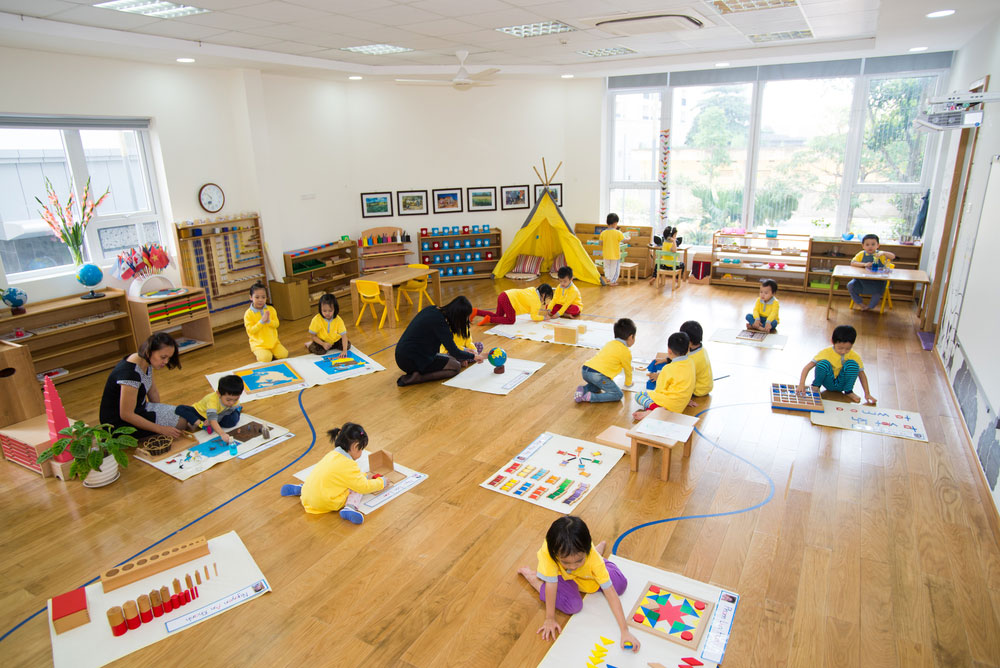
Visual Discrimination of Dimension
The study of dimension is a core component of the sensorial curriculum. Materials like the Cylinder Blocks, the Pink Tower, the Brown Stair, and the Red Rods are all designed to refine the child’s visual discrimination of size. Each material isolates a specific dimensional change: height, diameter, width, or length. For example, the Cylinder Blocks require the child to perceive subtle differences in both height and diameter to find the correct “home” for each cylinder. This is a high-level cognitive task that requires intense focus and visual scanning. By mastering these materials, the child develops an “educated eye” capable of noticing the geometric structure of the entire world around them.
The Pink Tower and Three-Dimensional Space
The Pink Tower is perhaps the most iconic Montessori material, yet its purpose is often misunderstood. It is not a block-building set; it is a lesson in the three-dimensional increase in size. As the child moves from the smallest 1cm cube to the largest 10cm cube, they are experiencing how volume grows in all directions simultaneously. In teacher training, we emphasize that the guide should present this material with economy of motion, highlighting the relationship between the cubes. When a child places the smallest cube on top of each successive cube to see the 1cm ledge, they are discovering a geometric constant. This physical experience of volume and dimension is the direct preparation for the study of solid geometry in the elementary years.
The Brown Stair and the Concept of Thickness
Complementing the Pink Tower is the Brown Stair (or Broad Stair), which isolates the qualities of width and height while the length remains constant. This material introduces the child to the concept of “thick” and “thin.” As the child arranges the prisms in order, they perceive a gradual progression of dimension. This work is essential for developing the child’s ability to categorize objects by their physical properties. It also reinforces the base-ten system, as there are ten prisms in the set. The child is literally building a physical map of mathematical sequences. This sensory experience of thickness prepares the mind for understanding surface area and the properties of quadrilaterals, making the transition to abstract math much more fluid.
The Red Rods and Linear Measurement
While the Pink Tower and Brown Stair deal with volume and thickness, the Red Rods focus exclusively on length. These ten rods vary from 10cm to 100cm (one meter). Because all the rods are the same color and thickness, the child’s attention is drawn solely to the linear dimension. This is the child’s first concrete experience with the metric system and the concept of a meter. Working with the Red Rods requires the child to coordinate their movements across a large space, as the longest rod is quite significant for a small child. This physical engagement with length prepares the child for the Number Rods in the Math area, where the same linear dimensions are used to teach the quantities one through ten. The Red Rods bridge the gap between sensorial perception and mathematical calculation.